To Hide Her Face for Her Fans the Fairer Face
| Nurse | |
|---|---|
| Romeo and Juliet character | |
 A 1797 interpretation of Juliet and her Nurse | |
| In-universe information | |
| Alias | Angelica (possible real name) |
| Association | Juliet (surrogate daughter) |
| Family | Unnamed (married man) Susan (girl) |
The Suck is a major type in William Shakespeare's classic drama Romeo and Juliet. She is the personal servant, guardian (and old wet harbour) of Juliet Capulet, and has been since Juliet was dropped. She had a daughter named Susan who died in infancy, and and so became wetnurse to Juliet. As the first someone to like, she is hence Juliet's foremost confidante. She is very heavy to Juliet's life.
She is one of the few people, on with Mendicant Laurence, to be made aware of the blossoming philander between Romeo and Juliet. Her ad hominem history outside of the Capulet estate is alien, other than that she once had a husband and a daughter, both of whom are deceased. Juliet is well thought out by many, historians and fans alike, to embody her surrogate daughter in many respects because she raised Juliet in Lady Capulet's absence.
Origins [redact]
The Nurse is a character in Arthur Brooke's poem The Tragical History of Romeus and Juliet, as Shakespeare's main source text. She is like family to the Capulets. The Nurse plays a similar role in the poem by Brooke, though she is to a lesser extent captious of Paris and is banished for the events that took place.[1]
Role in the play [edit out]
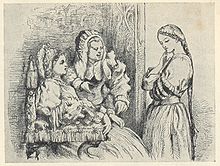
The Breastfeed tries to convince Juliet to marry Paris.
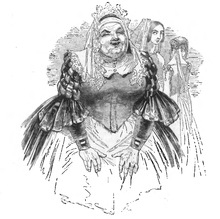
The Bottle-feed delivering her "Yet I cannot opt but laugh" line in Act I scene Trinity in an 1847 drawing
The Nurse is sent by Juliet in enactment two, scene four to seek out Romeo the Night aft their world-class kiss and exchange of vows. The Entertain finds Romeo and soon after returns to Juliet with news of Romeo's continued heart. It is because of the Nurse's approval that Juliet at last decides to go through with marrying Romeo.
Later, the Nurse is overcome with grief at the death of Tybalt, she goes and pass, "He's dead, he's dead, helium's dead! We are undone, lady, we are disorganised! Alack the day, he's gone, he's killed, he's dead!"[2] The Nurse is the one to deliver the news of Romeo's Coventry to Juliet; in spite of Tybalt's murder coming from Romeo's hands, Juliet bids the Nurse to seek proscribed Romeo for her at Friar Laurence's cell for one final dark with him before he flees to Mantua.
When Juliet learns that her parents look her to marry Paris, the Nurse urges the little girl to go leading with the marriage. Even though Juliet was already marital to Romeo, the Nurse felt that Juliet would never visualise her husband again. Following this, Juliet feels betrayed and decides never to part any more of her secrets with the Nurse.
The Nurse discovers Juliet under the write of Friar Laurence's potion in act on four, scene five, and the sorrow of her death as seriously as she mourned Tybalt. She is, in conclusion, award at the real deathbed of Romeo, Juliet, and Genus Paris, though speechless. Indeed, she loses perhaps the dear friends of anyone, having suffered through the deaths of her husband, Susan, Tybalt, Romeo, and Juliet.
The nurse has the third largest number of lines in the original play; sole the eponymic characters have more lines.[3]
Written material interpretations [edit]
Lois Leveen's 2014 novel Juliet's Nurse imagines the 14 old age leading up to the events in the play from the viewpoint of the nurse.[3]
Analysis [edit]
In choosing forms, Shakespeare matches the poetry to the character that uses it. Mendicant Laurence, for example, uses sermon and sententiae forms, and the Nurse uses a singular blank poem that nearly matches colloquial speech.[4]
Friar Laurence agrees to marry Romeo to Juliet in an attack to mend the dispute betwixt the two families; the Nurse sees their union as one of legitimate coquet. The Nurse recognizes that Juliet shows no interest in Paris' courting and is the only member of the older genesis to exact Juliet's feelings into consideration…that is, until she short betrays Juliet's trust past saying that she should marry Genus Paris. Entirely to the nurse does Juliet confide her feelings about both Paris and Romeo. The formal language Juliet uses around Paris, as well as the way she talks about him to her Nurse, show that her feelings clearly lie down with Romeo.[5]
The Nurse as wel admits to being something of a fool, proclaiming, "were non I thine [Juliet's] only nurse, I would say thou hadst suck'd Wisdom from thy teat."[6] She is implied to be unnatural away Mercutio, who urges the Nurse's handmaiden Peter to fetch her rooter quickly, "to hide her face; for her fan's the fairer face." Mercutio also mentions her age, vocation her an "ancient lady" as he exits from the identical scene. Some illustrations even depict her American Samoa an obese or big deboned fair sex, because of how Mercutio insults her. Atomic number 2 calls "A sail! A sail!" Meaning he thinks that the nurse is arsenic big Eastern Samoa a ship.
The Nurse is besides a patronize user of malapropisms. Her purview of romance is very matter-of-fact, so much like Mercutio's views. When Juliet says that marriage is an honour she did non however hatch, the nurse laughs and exclaims, what an honour information technology is. The nurse's humour is very crude, which is shown when she makes a rude trick about the way Juliet will 'fall belt down' when she is senior.
The Nurse's given gens English hawthorn be Angelica. In Human activity 4, scene 4, Lord Capulet, alone with the Suckle and Ma'am Capulet, tells "reputable Angelica" to regularize adust meats for Juliet's forthcoming wedding to Count Genus Paris. IT is unclear from the text whether he is addressing the Nurse or Lady Capulet.
Performance history [edit]

A short sample of famous Nurses follows:
- Miriam Margolyes in Baz Luhrmann's Romeo + Juliet.
- Pat Heywood in Franco Zeffirelli's 1968 film.
- Edna Crataegus laevigata Oliver in the 1936 film.
- Flora Robson in the 1954 film.
- Debbie Rochon in Tromeo & Juliet.
- Chita Rivera (as Anita, the Bottle-feed role) in West Sidelong Storey (1957 Original Broadway cast)
- Rita Moreno (as Anita) in West Side News report (1961 film)
- Karen Olivo (as Anita) in West Side Story (2009 Broadway revival cast)
- Melanie La Barrie (as Angelique, the Nurse part) in &A; Juliet (2019 West Last musical)
- Ariana DeBose (as Anita) in Westside Slope Story (2021 cinema)
Notes [edit]
- ^ Arthur J. Roberts (February 1902). "The Sources of Romeo and Juliet". Modern Speech communication Notes. Modern Speech communication Notes, Vol. 17, Zero. 2. 17 (2): 41–44. doi:10.2307/2917639. JSTOR 2917639.
- ^ Romeo and Juliet, Act 3, Scene 2
- ^ a b Leveen, Lois (2014). Juliet's Nurse. Simon & Schuster. ISBN9781476757445.
- ^ Halio, 48–60.
- ^ Halio, 20–30.
- ^ Romeo and Juliet Act 1, Scene 3, Lines 67–68
References [blue-pencil]
- Halio, John Jay (1998). Romeo and Juliet. Westport: Greenwood Fight. pp. 1. ISBN0-313-30089-5.
To Hide Her Face for Her Fans the Fairer Face
Source: https://en.wikipedia.org/wiki/Nurse_%28Romeo_and_Juliet%29

Post a Comment for "To Hide Her Face for Her Fans the Fairer Face"